Blog
Federal civilian agencies can no longer buy or run DeepSeek. On October 20, 2026, the Department of Homeland Security published an exclusion and removal order under the Federal Acquisition Supply Chain Security Act of 2018 (FASCSA). The order bars DeepSeek products from civilian agency procurement and requires agencies to remove the ones already on their systems. It is dated July 24, 2026.
Puck reports that the Office of the Director of National Intelligence issued a matching order the same day and that the Department of Defense acted in September. Citing the Congressional Research Service, Puck says this is the first time all three have acted against the same vendor. The DeepSeek ban also extends past DeepSeek’s own app and API to third-party products and services built with DeepSeek technology. That provision is the one acquisition teams on both sides of the transaction should read closely.
In “DeepSeek and Destroy,” Puck’s Ian Krietzberg examines whether the orders address the security risks they describe. His reporting finds broad agreement across both parties that the federal government should limit its reliance on Chinese AI. The orders follow bans on state devices in Texas and New York, as well as a 2025 House bill from Reps. Josh Gottheimer and Darin LaHood that would bar DeepSeek from federal devices.
Sources in the story questioned how agencies will trace and enforce the provision covering products made with DeepSeek. Several, including Rohirrim CEO and founder Steven Aberle, agreed that the national security concerns hold up, at least in part.
Aberle told Puck the orders were “no surprise to most of us who are in the know.”
Federal restrictions on DeepSeek have been building for nearly two years:
DHS pointed to the risk that the Chinese government could reach sensitive government data through DeepSeek’s infrastructure. Federal agencies should not carry that exposure inside their own systems.
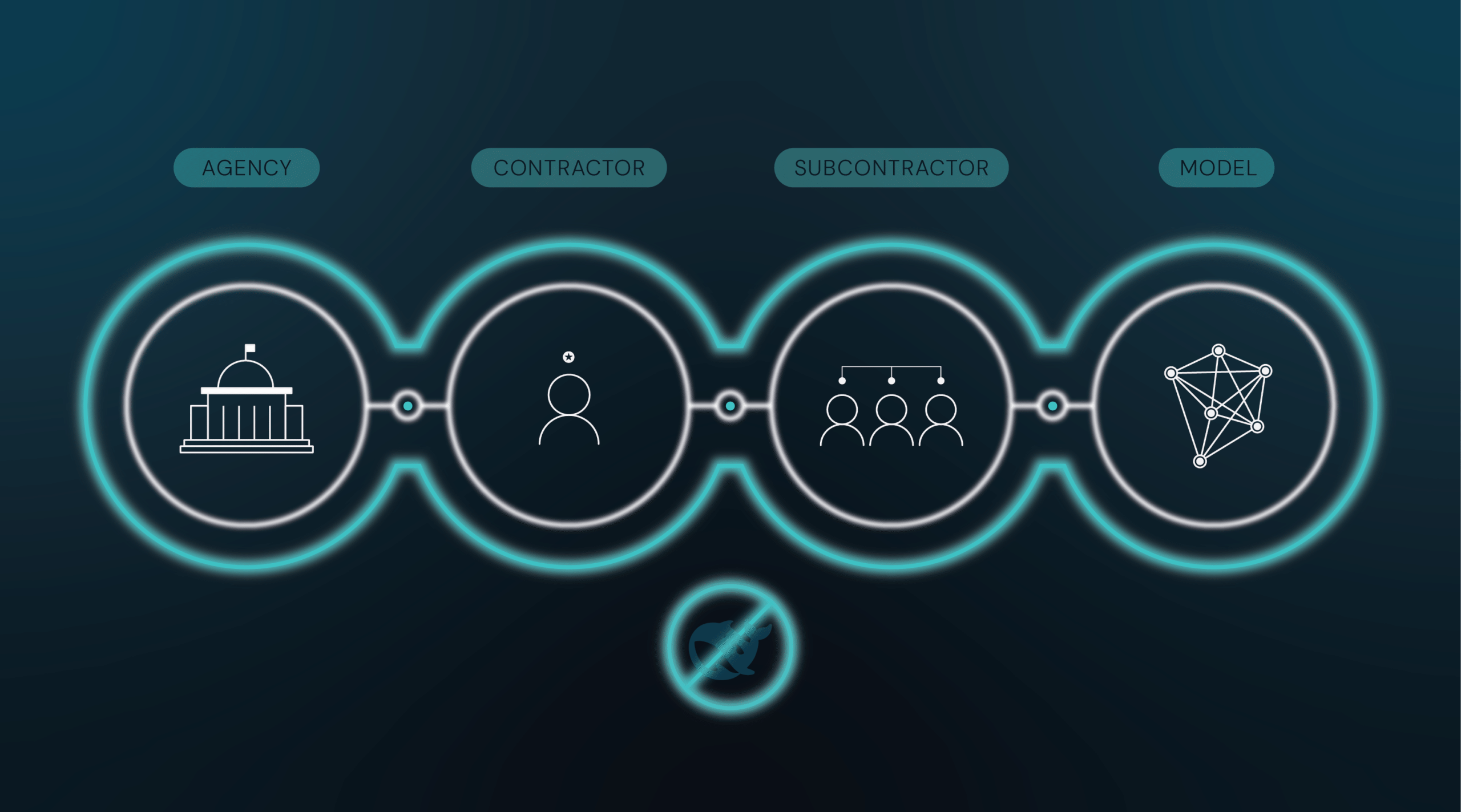
A FASCSA order applies to the full supply chain behind a product. Under the 2018 law, the Federal Acquisition Security Council recommends exclusion and removal orders, and three officials can issue them: the Secretary of Homeland Security for civilian agencies, the Secretary of Defense for defense and national security systems, and the Director of National Intelligence for the intelligence community. The council’s implementing rule allows these orders to reach prime contractors and subcontractors.
Three FASCSA orders now cover DeepSeek:
| Issuing official | What the order covers | When |
| Secretary of Homeland Security (DHS) | Federal civilian agencies | Signed July 24, 2026; published October 20, 2026 |
| Secretary of Defense (DoD) | Defense and national security systems | September 2026, according to Puck |
| Director of National Intelligence (ODNI) | The intelligence community | Same day as the DHS order, according to Puck |
The third-party provision is where most of the compliance work sits. An agency that never installed the DeepSeek app may still run a tool that calls a DeepSeek model in the background. A contractor that never chose DeepSeek may have picked it up through a subcontractor, a software library, or an open-weights model built on DeepSeek’s work.
Several people Puck interviewed expect scrutiny to extend past DeepSeek. Contractors that can document a clean model supply chain today will answer those questions faster when the next order arrives.
AI security now shapes acquisition decisions. Buyers want to know where a model came from, where their data goes, and who can reach it. Sellers need those answers ready before the question appears in a solicitation.
Rohirrim built the Unified Acquisition Platform™ for that standard. UnifiedAcquire™ serves government and commercial buyers, and UnifiedRespond™ serves proposal and capture teams. Both run on single-tenant private architecture, with support for CMMC-compliant deployments and DoD IL5 environments on Azure Government Cloud. Rohirrim does not use DeepSeek models or components anywhere in its platform.
Acquisition has to move at the speed of need. The AI behind it has to be trusted at every layer.
Is DeepSeek banned in the United States?
DeepSeek is banned across federal civilian agencies under a DHS order published October 20, 2026, and the Department of Defense and the intelligence community have their own restrictions. The order does not apply to private companies or individual users. Several states also prohibit DeepSeek on government devices and networks.
What is a FASCSA order?
A FASCSA order is an exclusion or removal order issued under the Federal Acquisition Supply Chain Security Act of 2018. It bars a vendor’s products from federal procurement, requires agencies to remove existing deployments, or both. The Secretary of Homeland Security, the Secretary of Defense, and the Director of National Intelligence can each issue one.
Does the DeepSeek ban apply to government contractors?
Yes. The DHS order covers third-party products and services developed using DeepSeek, and FASCSA orders can reach prime contractors and subcontractors. Contractors selling AI-enabled products to civilian agencies should confirm that no DeepSeek model or component sits anywhere in their offering, including inside subcontracted work.
Why did the US ban DeepSeek?
DHS cited the risk that the Chinese government could access sensitive U.S. government data through DeepSeek’s infrastructure, and the possibility that its models contain malware or other security vulnerabilities. The order was issued under the Federal Acquisition Supply Chain Security Act, which lets federal officials bar risky technology from government systems.
Can federal agencies get an exception to the DeepSeek ban?
Yes. Agencies can request an exception within 60 days of the order’s issuance by submitting a written justification and proposed risk mitigations. CISA reviews each request and approves or denies it in writing. CISA also offers technical help to agencies that cannot remove covered products on their own.
See how the Unified Acquisition Platform keeps acquisition AI secure for buyers and sellers. Request a demo.